In a game brimming with tension, precision, and world-class talent, it wasn’t the goals or tactical battles that stole the spotlight — it was the technology. Once again, VAR (Video Assistant Referee) became the centerpiece of football discourse following Arsenal’s dramatic Champions League clash with Real Madrid.
What unfolded at the Emirates wasn’t just a football match; it was a case study in how subjectivity, speed, and the spirit of the game all collide in the modern era of officiating. At the center of it all? Two critical penalty calls — one awarded to Arsenal, and one initially awarded to Real Madrid before being controversially overturned. The outcome of both decisions hinged on fine margins, player behavior, and an ever-evolving understanding of what VAR should be.
Let’s unpack each moment in detail, analyzing not just what happened, but why — and what it says about the current state of football officiating.
The First Flashpoint: Merino vs. Asencio
What Happened
The game was just nine minutes old when Arsenal won a corner. Declan Rice stepped up to deliver a lofted ball into the box. As the ball swung in, Mikel Merino, positioned near the penalty spot, went to ground under pressure from Raúl Asencio. Referee François Letexier didn’t hesitate — he waved play on. It seemed to be one of those moments you see a dozen times in a game: a tangle in the box, bodies colliding, and the referee deciding there wasn’t enough to merit a foul.
But the VAR saw something different.
Within moments, Letexier was called to the pitch-side monitor by Jérôme Brisard, the appointed VAR. The review was brief, lasting just over two minutes. After watching the footage, Letexier returned to the pitch, pointed to the spot, and awarded Arsenal a penalty.
Bukayo Saka stepped up, but Thibaut Courtois denied him with a superb save. Despite the miss, it was the decision to give the penalty that caused the biggest stir — not just among fans, but among pundits, players, and even rival teams.
The VAR Review
So, why was it given?
In the VAR room, the process is governed by a key principle: the impact of contact. Holding in the box is not inherently an offense. Players jostle for position all the time. The question is whether the hold materially affects the player’s ability to challenge for the ball.
In this case, Asencio had a clear grip on Merino’s shirt. But was it enough to prevent him from playing the ball? That’s the subjective call the VAR had to make. The quick review suggested that yes, the hold was significant enough to warrant intervention.
What complicated the matter is that Merino was moving toward the ball’s likely drop zone. That matters. If the attacker is in a position to reasonably contest the ball and is impeded, the chance of a penalty being given goes up. If they’re not in play — for example, if the ball is headed well over their heads or behind them — referees and VARs are more reluctant to give a spot kick.
Still, many argued that the decision was soft. The kind of holding that occurred happens in almost every corner — so why this time? The answer might lie in timing, visibility, and pressure. Asencio’s hold came just as Merino tried to jump. The timing made the contact more obvious and potentially more impactful. And on a night of high stakes, referees tend to err on the side of caution — or perhaps reaction.
The Second Controversy: Rice vs. Mbappé
What Happened
If the Arsenal penalty caused a stir, what came next caused a storm.
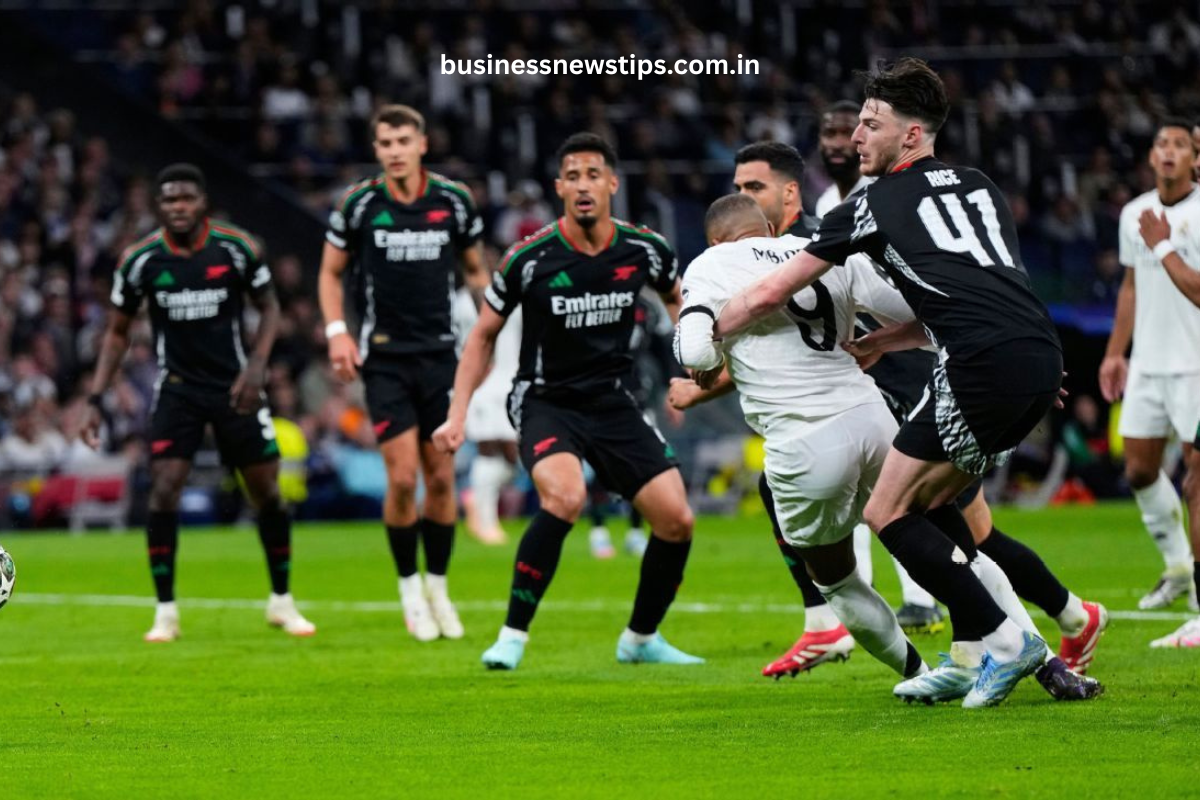
In the 23rd minute, Real Madrid mounted an attack. Lucas Vázquez played a clever ball forward, flicked on by Asencio. Kylian Mbappé, lurking with intent, turned toward the ball and suddenly went to ground. Declan Rice was close by, and the referee immediately pointed to the spot. A yellow card was also issued to Rice, ruling him out of the next match — a potential semi-final first leg.
From the outset, the decision felt hasty. Mbappé fell dramatically, with minimal contact, and Arsenal players immediately surrounded the referee. But Letexier seemed convinced. It wasn’t until VAR stepped in that the tide began to turn.
After a painstaking five-minute review, Letexier was called to the monitor again. When he returned, he overturned the penalty. The yellow card for Rice was rescinded. The crowd erupted — not in celebration, but in confusion. What exactly had just happened?
The VAR Review
Here’s where things get murky.
Unlike the Merino incident, this one had multiple layers. First, there was the question of the foul: did Rice impede Mbappé illegally? Replays showed Rice had his arm across Mbappé’s upper body, but contact was minimal. Crucially, Mbappé appeared to initiate the fall, going down far too easily for the contact applied.
In football, upper-body contact is often judged differently than lower-body fouls. If a player is tripped or kicked in the legs, even small contact can justify a penalty. But when it’s a hand on the shoulder or an arm across the chest, officials tend to consider how much actual impact the contact had. Did it unbalance the player? Was it forceful? Or was it just part of normal defensive pressure?
VAR seemed to conclude that Rice’s contact didn’t meet the threshold. It was, essentially, not enough to justify a penalty — let alone a yellow card.
But then came the offside confusion. The TV broadcast mistakenly displayed an offside graphic, leading viewers to believe the penalty was overturned due to an offside in the buildup. In reality, no offside was given, and play resumed with a dropped ball to Arsenal’s goalkeeper.
This only added to the chaos. Why had it taken five minutes? Why was the referee not sent to the monitor sooner to check offside simultaneously with the foul? And why does a similar level of contact lead to opposite decisions — a penalty for Arsenal, but none for Madrid?
Frequently Asked Questions
Why was the penalty awarded to Arsenal in the first instance?
The penalty was awarded after VAR reviewed a situation where Raúl Asencio was holding Mikel Merino in the penalty box during an Arsenal corner. The VAR determined that the hold was significant enough to affect Merino’s ability to challenge for the ball, thus justifying the decision to award a penalty.
What was the controversy around the penalty decision for Real Madrid?
The penalty awarded to Real Madrid’s Kylian Mbappé was overturned after VAR review. Although Declan Rice had his arm across Mbappé’s body, the VAR deemed the contact too minimal to justify a penalty. The decision sparked debate because the contact appeared to be similar to the one in the Arsenal incident, yet no penalty was given to Madrid.
How long did it take for the VAR review to make a decision?
The VAR review for the Arsenal penalty was completed in just over two minutes, whereas the review for the Mbappé penalty took five minutes, causing confusion and frustration. The delay was partly due to the offside check, which incorrectly appeared on television graphics, adding to the confusion.
Why was there confusion over the offside graphic during the Mbappé penalty review?
The offside graphic shown on TV was incorrect. The decision to overturn the penalty was not due to offside but rather due to the insufficient contact by Rice on Mbappé. The incorrect graphic led to further confusion for both viewers and commentators.
Why do similar incidents (holding) result in different VAR decisions?
Each VAR decision is highly subjective and based on the context of the situation. In cases of holding, the key factor is the impact of the contact. If holding prevents a player from challenging for the ball, a penalty may be awarded. In contrast, if the hold is minimal and does not significantly affect the player’s ability to contest the ball, a penalty may not be given. This subjectivity leads to varying decisions even in similar situations.
Conclusion
The Arsenal vs. Real Madrid Champions League match provided another memorable chapter in the ongoing evolution of VAR in football. While the technology has undoubtedly helped eliminate clear errors, as demonstrated by the overturned penalty for Real Madrid, it has also raised further questions about consistency, transparency, and the subjectivity of decisions. The contrasting decisions in the same match — a penalty awarded to Arsenal for a soft holding foul and one overturned for Real Madrid despite similar contact — underscore the challenge of maintaining consistency in VAR reviews.
