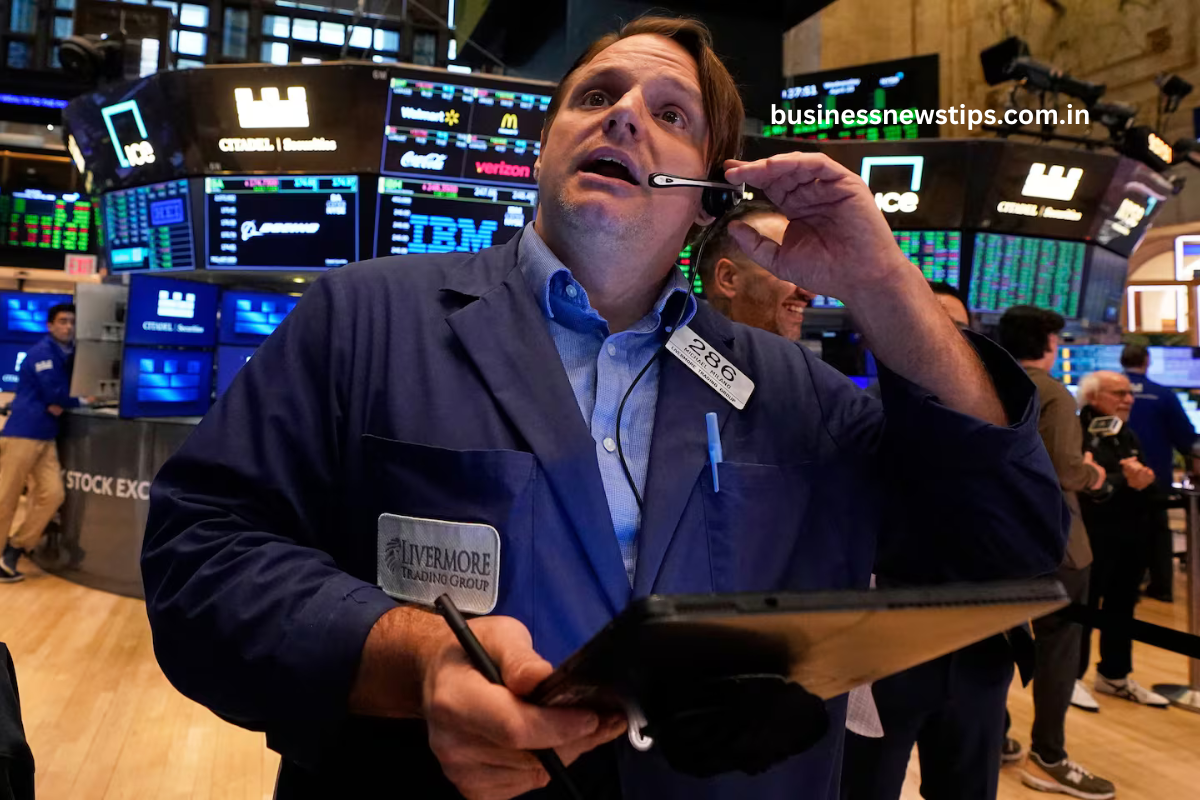
The U.S. stock market closed solidly higher on Wednesday, April 23, 2025, despite retreating from the highs that were achieved earlier in the session. The rally came as investor concerns surrounding tariffs and Federal Reserve independence were alleviated by President Donald Trump’s recent comments. The market saw broad-based gains across major indices, with technology stocks leading the charge, driven by optimism regarding the trade war and Trump’s statements.
Major Indexes Show Strong Gains
The S&P 500, which represents a broad swath of U.S. companies, gained 1.7%, marking a significant recovery from the early-week sell-off. The tech-heavy Nasdaq Composite fared even better, climbing 2.5% by the end of the session, reflecting the strong performance in technology stocks. The Dow Jones Industrial Average, the oldest of the major stock indices, advanced by 1.1%, or over 400 points, though it had surged nearly 1,200 points in the early morning hours before retreating somewhat.
Despite these gains, stocks were well off their early-session highs. The day’s rally was fueled in part by comments from President Trump, which reassured markets that some of the worst fears surrounding tariffs and the Federal Reserve’s independence might be overstated.
Investor Anxiety Eases with Trump’s Comments
Investor anxiety had been mounting earlier in the week as President Trump had taken to criticizing the Federal Reserve’s monetary policy and the economic impact of tariffs. Trump’s vocal disapproval of Fed Chair Jerome Powell had been a source of significant concern for market participants. Just a day prior to Wednesday’s rally, the Dow had surged more than 1,000 points, recovering from sharp declines spurred by worries over trade and interest rates.
On Tuesday evening, President Trump’s comments began to shift investor sentiment. He announced that tariffs on Chinese imports would be “substantially” lower than the 145% rate that had been previously proposed. This revelation boosted optimism, as it signaled the possibility of a breakthrough in the ongoing trade disputes with China, as well as potentially lower tariffs for other nations involved in trade talks with the U.S.
Additionally, Trump addressed concerns about his stance on Federal Reserve policy. He had previously described Powell as a “major loser” and expressed a desire to see him removed from office. Trump made it clear on Wednesday, however, that he had “no intention” of firing Powell, and further emphasized that while he would prefer to see the Fed lower interest rates, he did not plan to take drastic actions against the central bank.
These two key developments—reduced tariff concerns and an apparent softening of Trump’s rhetoric toward Powell—helped ease fears about the future trajectory of U.S. monetary policy and international trade, contributing to the day’s strong rally in the stock market.
Tech Stocks Lead the Rally
Among the standout performers on Wednesday were technology stocks, which surged on the back of improving sentiment toward the U.S.-China trade relationship. Semiconductor stocks, in particular, had been some of the hardest hit during the earlier stages of the trade dispute, but they rebounded strongly on Wednesday.
Notably, chipmakers Nvidia (NVDA) and Broadcom (AVGO) each rose by around 4%, while Advanced Micro Devices (AMD) and Intel (INTC) posted gains of 5%. Marvell Technology (MRVL) was among the strongest performers in the sector, surging by 6%. The VanEck Semiconductor ETF (SMH), which tracks a basket of semiconductor stocks, gained nearly 4%.
This rally in chip stocks was not only a reaction to the easing trade tensions but also a reflection of the broader optimism in the tech sector, where many companies stand to benefit from continued demand for advanced semiconductors and other technology products.
Another notable sector leader was electric vehicle (EV) maker Tesla (TSLA), which gained 5% despite reporting weaker-than-expected earnings in its latest quarterly report. Tesla’s gains were fueled by CEO Elon Musk’s comments that he would be dedicating more time to the company, signaling a renewed focus on its core operations rather than his work with the Trump administration.
Other large-cap tech stocks, including Amazon (AMZN), Meta Platforms (META), Apple (AAPL), Microsoft (MSFT), and Alphabet (GOOG), all posted strong gains as well. Amazon and Meta both rose 4%, while Apple, Microsoft, and Alphabet saw smaller but still significant increases of about 2%.
Among other tech stocks, Palantir (PLTR), a data analytics software company, and Super Micro Computer (SMCI), a provider of servers, each saw impressive gains of more than 7%. Super Micro Computer, in particular, announced a new collaboration with Japanese technology giant Fujitsu to deploy a new server for a large language model (LLM) project, further fueling investor enthusiasm for the stock.
Strong Earnings Reports Lift Non-Tech Stocks
While technology stocks dominated the session, other sectors also saw notable movements driven by strong earnings reports. General Electric’s (GE) renewables division, GE Vernova, rose by 3% after reporting better-than-expected quarterly results. Similarly, aerospace giant Boeing (BA) saw a 6% increase in its stock price following a solid earnings beat, driven by increased demand for commercial aircraft and a recovering global airline industry.
Telecommunications company AT&T (T), which had been under pressure in recent months due to increased competition in the telecom industry, gained about 1% after reporting solid quarterly results that exceeded analyst expectations.
The rally also extended to energy stocks, although the performance was mixed in this sector. Bitcoin’s rise, driven by an increase in risk appetite, pushed cryptocurrency stocks higher, and energy stocks like ExxonMobil and Chevron (CVX) followed suit, although West Texas Intermediate (WTI) crude oil prices fell by 2.2% to $62.30 per barrel.
Commodities and the U.S. Dollar
The commodities market saw some volatility on Wednesday. Gold futures, which had spiked to a record high of approximately $3,500 per ounce earlier in the week, retreated by 3.5%, falling to $3,300 per ounce. The pullback in gold prices came as investors rotated out of safe-haven assets and into riskier assets like stocks.
Meanwhile, the U.S. dollar continued its upward march. The U.S. Dollar Index, which measures the dollar against a basket of foreign currencies, rose by 1% to 99.86, adding to Tuesday’s gains. The dollar had previously fallen to a low of 97.92 on Monday, which was the weakest level since March 2022, as Trump’s comments about the Fed and his calls for lower interest rates unsettled global markets.
The yield on the 10-year Treasury note, a key indicator of long-term interest rates, remained stable at 4.39%, after rising from a low earlier in the day of 4.26%. The stability of Treasury yields, combined with a stronger dollar, suggested that investors were feeling more confident about the direction of the U.S. economy, despite the uncertainties that had been surrounding tariffs and Fed policy.
Bitcoin Continues Its Surge
Bitcoin, the world’s leading cryptocurrency, also saw significant movement on Wednesday. After hitting an overnight low of around $91,000, the digital currency surged to $93,500 by the late afternoon, marking a 25% increase from its early-April low. The rally in Bitcoin was attributed to a broader increase in risk appetite among investors, many of whom had been cautious earlier in the month due to concerns about trade tensions and monetary policy. Bitcoin’s rise was also supported by growing institutional interest in digital assets as an alternative investment class.
Frequently Asked Question
Why did the stock market rise on April 23, 2025?
The stock market rose due to President Trump easing concerns over tariffs and the Federal Reserve’s independence. His comments about lowering tariffs on Chinese imports and his decision not to fire Fed Chair Jerome Powell boosted investor confidence.
What did President Trump say about tariffs?
President Trump announced that tariffs on Chinese imports would be “substantially” lower than the 145% rate previously proposed, which helped alleviate market fears about the trade war.
How did President Trump’s comments affect the Federal Reserve?
Trump reassured investors that he had “no intention” of firing Federal Reserve Chair Jerome Powell, which helped stabilize market concerns about the Fed’s independence. However, Trump expressed his desire for the Fed to cut interest rates.
Which sectors performed well in the market rally?
Technology stocks, particularly chipmakers like Nvidia, AMD, and Intel, saw significant gains. Other sectors like aerospace, telecom, and renewables also performed well, with companies such as Boeing, AT&T, and GE Vernova posting solid earnings.
What impact did the market rally have on cryptocurrencies?
Cryptocurrency markets, particularly Bitcoin, saw gains as a result of increased risk appetite among investors.
Conclusion
The strong performance of the stock market on Wednesday, April 23, 2025, was a clear indication of a shift in investor sentiment. While the rally was broad-based, the driving factors were President Trump’s comments on tariffs and the Federal Reserve, as well as solid earnings reports from both tech and non-tech companies.
Despite the optimism, some caution remained, as evidenced by the retreat from the highs seen earlier in the day. The continued volatility in commodity markets, particularly in gold and oil, as well as the fluctuations in the U.S. dollar and Treasury yields, suggest that investors will need to remain vigilant in the coming weeks. However, the easing of concerns about the trade war and the Fed’s independence provides a strong foundation for the market to continue its recovery.
